Today, we have 68 children learning and staying on the unit, ten teachers, and seven supporting staff. We're supporting these children with a quality education that meets their unique needs while also providing guidance and counseling to their families so that the whole family can thrive.

Sr. Bonny is training children and some staff on skills in sack gardening
Our goal is to help these children and others to lead fulfilling lives, find their place in the community, and be in families.
Our programs seek to engage through - not only formal education but also family assistance and community events. Many children in our district villages around Rukungiri have disabilities, are deaf, or HOH.
These children have a dire need for our services but unfortunately lack the scholastic material fees, uniform fees, beddings, and even clothing.
We want to be able to provide those critically vulnerable families with food, clothing, and resources so that children can begin their schooling while staying in their loving families.
If the child's home is in critical condition, we also are raising funds to help support families with safer houses.
Nyakibale Lower pupils smiling, giggling, and having fun competing with other students in rope skipping
Currently, we support:

Sack gardening training taught by Sr. Bonny
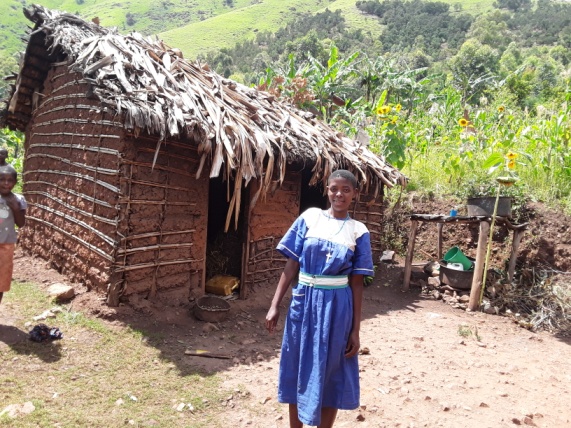
Lovence is now happily reunited with her family
What is Family-based care?
The focus of Family-based care is providing the love, nurture, and security that allows a child to thrive through reunification with biological parents, kinship care, foster care, or adoption.
Also, a vital part of supporting family care is strengthening families to prevent unnecessary separation.
Our Work
To ensure the sustainability of family-based care, we are doing the following:
Changing the way we care to a family-based approach
Children should be families and kinship care, not orphanages.
Research affirms that the best environment for children is within a loving, secure family.
At Nyakibale Lower Deaf Unit, we seek the best interest of each child, which is finding a permanent family setting as soon as reuniting is possible.
We will still provide community-based services for street boys.
Children have the best chance to thrive when they grow up in a family. That's why we're committed to strengthening families, and we are now shifting towards a family-based care model.
Our Work
and why it matters.
Our program's transition emphasizes sustainable family-based care more than institutionalization while seeking street children's best interests

Nyakibale Lower children playing after class
Nyakibale Lower pupils dancing and entertaining visitors from the Parliamentary Committee
Our Programs
We want to see a society where all children have access to quality, inclusive education and are empowered live to their full potential with their rights advocated for in the community.
Transitioning our care model
We're raising funds to transition our model from institution-based care to family and community-based care. Our programs seek to engage through - not only formal education but also family assistance and community events.
Transitioning our model of care will attract more children to attain education, thus increasing our impact on the community.
Challenging statistics
We'll also be helping children and their families experiencing poverty, family issues, and lack of services. Our program also aims to protect children by mitigating child abuse cases and ending childhood marriages by advocating for child protection, child development, and the importance of children in school within the community.
It's also our goal in transitioning our model to reduce the number of child suicide attempts by providing counseling and therapy to children to help them find support, empowerment, hope, and purpose.
Helping resettled children
For those who previously stayed on our unit and have resettled into families, we are also raising funds for the travel costs associated with follow-ups to assess the progress of families after reuniting and make referrals and recommendations when necessary.
Supporting children still on our unit to be in families
For the children who attend Nyakibale Lower Primary School or live on the unit, we seek to improve our facilities by adding more pathways and ramps to accommodate children of all abilities and needs better. We also strive to improve our school's infrastructure as a whole.
To reunite children who live on our unit with their families, we also have travel costs for tracing and screening of families where a social worker will conduct a home visit and family interviews to collect data of a child's family and community background.

Continuum of Care
Child-centered and family-based education
Nyakibale Lower Deaf Unit is raising funds to provide more children with child-centered, family-focused education for children with disabilities. We offer formal education, creating a favorable learning environment to provide quality learning in children with disabilities or special needs.
The deaf unit also empowers the children who attend our school with positive attitudes and a positive self-concept. Through counseling and facilitation of practical skills, children can appreciate themselves better and, in turn, be appreciated within the community. Improving self-esteem also increases opportunities for children to share balanced life as they dream bigger than before, reaching their goals and aspirations; socially, intellectually, economically, and spiritually.
Because family is so essential in a child's development, we also make space for a child and their family to grow in their bond, love, and appreciation for one another. We consider each child's familial norms, cultural values, and traditions with each case to make sure we can better understand and help each child/family as individuals.
We conduct home visits for the parents who don't come to visit their children at school to access the family background and status. In addition, we educate families and caregivers on how to go about the identified issues that children face at home. We equip families through education, financial empowerment, child and youth development, and spiritual growth. We elevate families through family coaching, counseling, and spiritual enrichment.
Reunification of our children on the unit with their families happens three times a year. We also encourage family visitation and involvement to strengthen the bond in the child's relationships while learning and understanding their family's cultural norms and beliefs for developing self-identity
Family strengthening and income-generating projects
We provide education, healthcare, spiritual development, and skills training to build a strong foundation for empowerment and self-sufficiency. Also, we help parents gain skills that can help sustain their families for the long-term, including:
- Visiting homes for psychosocial support and data collection
- Necessities, such as food and healthcare as needed
- Parenting skills and caregiver education
- Family support counseling via trained therapists and social workers
- Life skills training
- Economic planning and job skill development so that they earn income from trade skills, such as baking, knitting, sewing, welding, computers, bookkeeping, and more
- Sensitize the parents on the importance of educating the children with disabilities
- Teach sign languages for accessible communication